
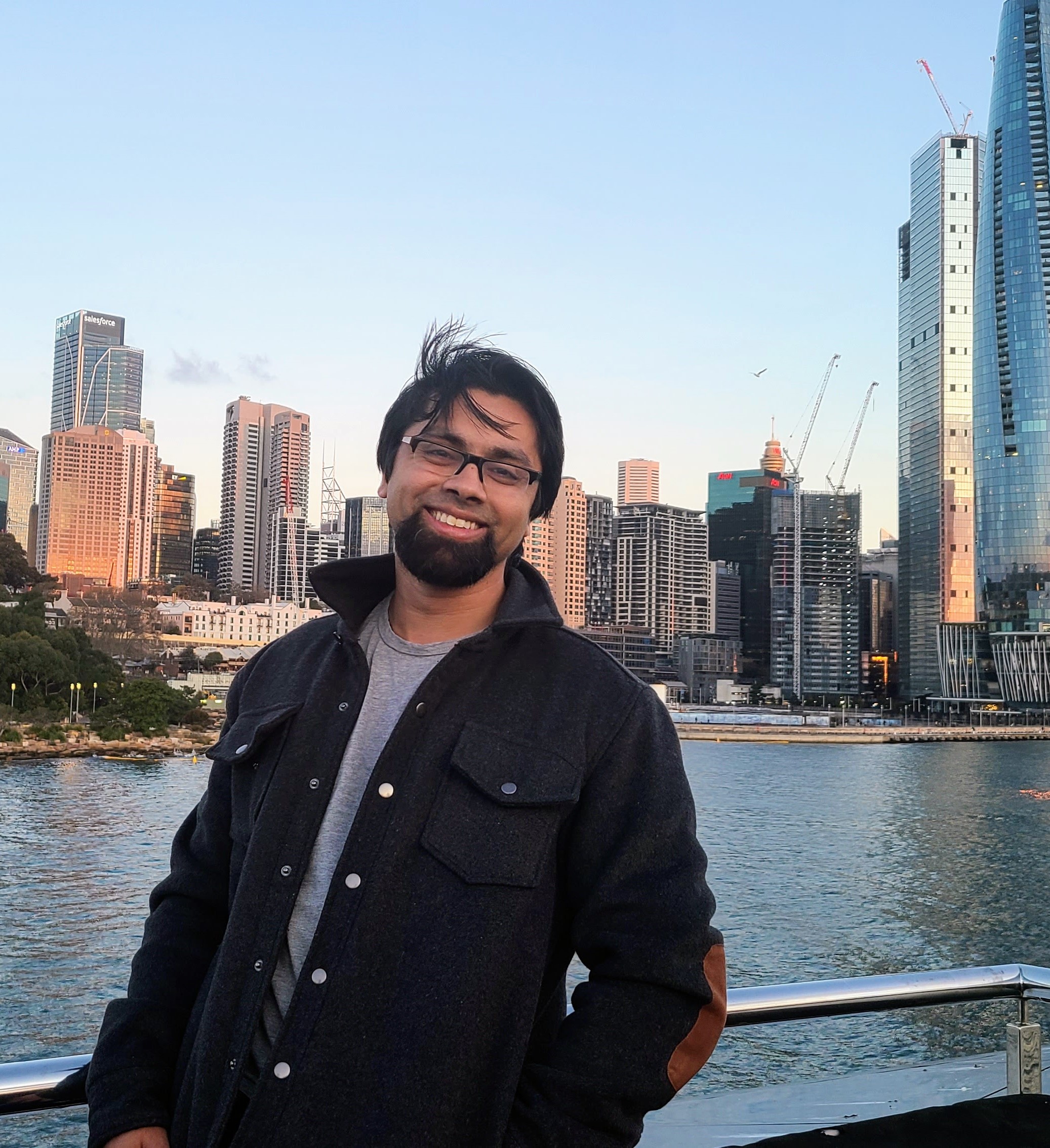
I am Tirthankar Chakraborty (I often go by TC), an Earth scientist in the Earth System Modeling Group within the Integrated Discovery Sciences Directorate of the Pacific Northwest National Laboratory in the U.S. I am currently working on developing and improving urban representation in land models using various observational products, including satellite-derived estimates, and examining extreme events over coastal cities.
My broad research interest is in biosphere-atmosphere interactions and I have worked on this topic at multiple scales using various methods. I received my PhD from the Yale School of the Environment in 2021 with a focus on Earth & Environmental Science. For my dissertation, I worked on developing a surface energy budget perspective to aerosol-climate interactions by combining theory and global climate modeling. A major focus was on the importance of the diffuse radiation fertilization effect for terrestrial processes and uncertainties in diffuse radiation in current-generation modeling and observational systems, some of which I bias-corrected using machine learning algorithms. Previously, my master's thesis was on urban climate, particularly the urban heat island effect, which I have continued working on over the years using satellite measurements, crowdsourced weather station data, and both process-based and data-driven modeling frameworks.
I think cities will be the nexus of climate adaptation in the future and I am very interested in optimal strategies for minimizing urban heat stress, its disparities, and other downstream effects on physical and human systems. While I have done field and lab work in the past, most of my current research involves sitting in front of the computer and coding. I received the U.S. Department of Energy Office of Science Early Career grant in 2023 to improve urban representation in Earth system models through planetary-scale data-model integration. I am also a lead or institutional PI on several other projects funded by DOE, NASA, and NIH (check out the 'Research Projects' tab). Across these projects and sometimes outside them, I advise postdoctoral scholars and graduate students at PNNL and partner universities, including serving on PhD dissertation committees (see the 'Mentorship' tab).
My past and ongoing contributions to the field include developing the most comprehensive global to national surface and canopy urban heat island datasets, conducting some of the first large-scale studies on urban surface and moist heat stress disparities, isolating urban warming signals from regional to continental scales, examining the impact of humidity feedback on outdoor moist heat stress due to urbanization, irrigation, and coastal processes, assessing the fitness-of-use across global urban data products and satellite-derived algorithms, examining the efficiency of urban trees on overall and equitable heat mitigation, and improving how urban areas are represented in Earth system to numerical weather models.
I frequently use the Google Earth Engine platform for large-scale geospatial analysis and algorithm development, and occasionally offer a workshop on its JavaScript API. I have used this platform to develop web applications to visualize and disseminate global to regional geospatial datasets. I have also written community tutorials on using the platform (Beginner's Cookbook, Customizing Base Map Styles, Creating Web Apps). I was one of the 26 inaugural Google Developer Experts for Earth Engine and still contribute to this community through the Earth Engine Insiders program.
I currently serve as an Associate Editor of the American Geophysical Union's Journal of Geophysical Research: Atmospheres and Earth's Future, primarily handling manuscripts on atmosphere-biosphere interactions, urban climate, and machine learning applications in the Earth sciences. I am also on the American Meteorological Society's Board of Environment and Health and Chair of the International Association for Urban Climate's Early Career Committee.
If you want to collaborate or want more information about my work, check out my projects and publications (and my Google Scholar profile for an up-to-date list) or reach out to me through: